



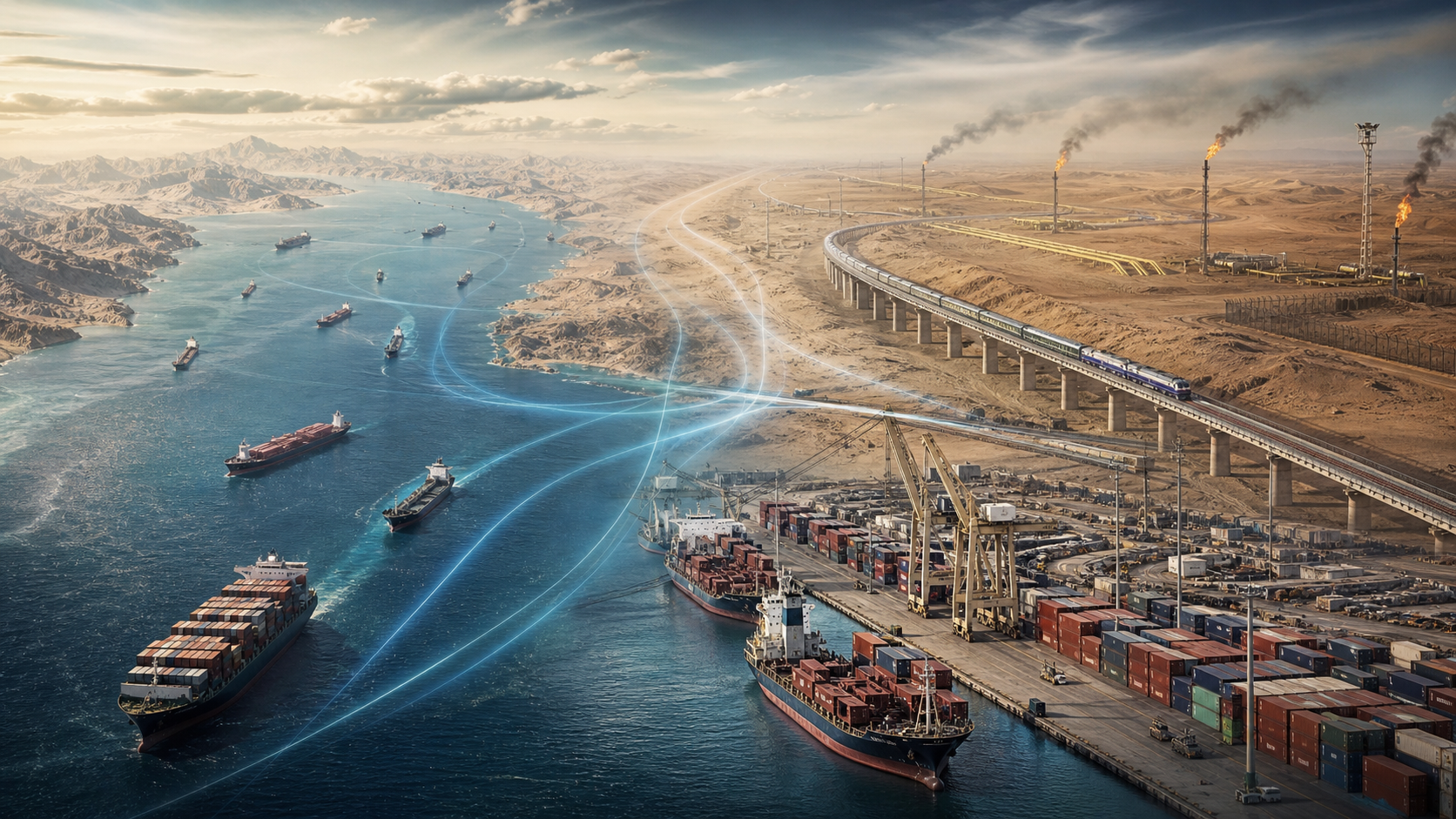
The old world, five centuries in the making, is dying. Not merely passing through a crisis but choking in a fifty-five-kilometer strait. This isn’t some sirocco[1] gust that’s upset a casual weekly game of kharbga[2]. The board itself is being redrawn, with different rules, and perhaps even new players.
In this new game, Algeria is no marginal square. It is a shoreline, a depth, an energy reserve, a threshold between the Mediterranean, Africa, the Arab world, and the Sahara. The question is whether it will stop letting itself be described as a country situated between others and start thinking of itself as a power capable of magnetizing them.
The first squall has already struck. Hormuz sealed. Twenty million barrels locked each day in the bellies of tankers and storage terminals. Liquefied gas held hostage behind a curtain of missiles. Soon the wells will give their first death rattles. Tomorrow, they will return, diminished, stripped of the easy abundance that yesterday they simply poured forth. Even the optimists quietly admit it will take years. The illusion still dances on paper. The physical barrel, meanwhile, trades at a thirty-to-forty-dollar premium over the futures contracts. Paper chases communiqués, but crude no longer negotiates: it obeys the material world. Prices will stay high, but they will grow increasingly volatile.
The Brutal Return of the Material World
Yet the heart of the tragedy lies elsewhere. Shortages have already begun, still discreet, already in motion. The global economy’s blood vessels are atrophying. What circulates less always ends up transforming that which produces, which eats, which finances itself, and which governs.
The second squall is already upon us. It doesn’t smell of oil. It goes for the invisible matter of fossil civilization: naphtha, sulfur, ethylene, propylene, benzene, ammonia and even the helium in our microchips. These intermediate products then cease to be mere technical variables. They become again what they have always been: the material conditions of the modern world. When they run short, it is the discreet foundations of the industrial world that begin to crack.
The third squall reaches the mineral skeleton of the global economy. Metals need energy, but they also need chemistry. Without acids, without leaching, without reactants, copper, lithium, nickel, cobalt, aluminum or steel remain prisoners of their rocky shells. The mineral frame waits, inert, for the return of the energy, the chemistry, and the routes capable of transforming a dormant resource into industrial power. Even the energy transition then discovers its dependence on the old world it claims to be replacing.
When Paper Catches Fire
The fourth squall is one of mechanical impotence. Factories, foundries, assembly lines, logistics: the body’s muscles will weaken. Without oil and gas for the machines and transport, without petrochemicals for the components, without metals for the wiring and the framework, plants will first go slow, then some will halt. Unemployment will spread in patches, first through the most exposed sectors, then through the links that seemed protected. No one knows whether the industrial body will scar over or remain lastingly diminished.
The fifth squall, quieter, more patient, will blow across our plates. Without sulfur, without urea, fertilizer plants stutter and stop. The farmer prays. Arid tears of despair cannot wet the soil. He sows less, or differently. In lands with deep black earth, the shortages will be an irritation. In comfortable nations, food will cost more and the shelves, at times, will empty. But elsewhere, where the topsoil is thin and the state is brittle, famine will wreak its havoc, and the planet’s digestive system will turn gangrenous.
The sixth squall will spread like a firestorm. It will carry the smell of charred paper. Sovereign debts, swollen by years of free money, will buckle under the weight of interest rates and war budgets. The bubbles, from artificial intelligence to private credit, will cease to cloak the material world on which they depended. The insurance market, already battered by the Hormuz shock, is listing and may well capsize. The yen-dollar carry trade, that silent trillion-dollar gamble, will unwind amidst a panic. The financial nervous system will in turn go haywire. Deprived of coordination, the economic body will lose its capacity to convey trust.
Towards a New Order of Corridors and Resources
Once the economic body gravely weakened, the seventh squall will begin redrawing the board. It will usher in the age of the great troubles. When bread runs short and order trembles, the wretched of the earth have but two paths: accept what was written or start moving. Every nation, fevered, will follow its own reflexes: sudden revolutions, mass migrations, identitarian retreat. The contagion will bleed into zones we believed healthy and immune. Already, a nationalism of flows is taking root: more and more states choose to lock their riches in the safe ground of the earth rather than trust the markets to make them grow.
After the seventh, the squalls that follow will reveal the rules of the new game. The eighth will set the lawful moves: overland corridors and sea-lanes thrust into competition for the same lifeblood flows. The ninth will cut more bluntly still: only the countries able to secure energy, water and minerals will remain in the game; the others, yesterday given as winners, will already have lost their pieces. The tenth squall will ratify the new order: alliances founded less on military pacts than on shared corridors, woven from physical interdependence. Tomorrow, the decisive alliance may not be the one that promises to defend a capital, but the one that guarantees a port, a mine, an aquifer, a cable, a factory, or a road.
Then come the final minutes of the game: the slowest to the eye, but the most gripping, for they are a struggle for the soul of the world to come. The generation born after the war will already play upon a different board. Yet the players will still contest its cosmogony. With the eleventh squall, a new spirit will take hold: not nostalgia for the lost, but a cast of mind shaped by stability, energy, water, minerals, the local. The “Hormuz crisis” will echo in their ears the way “the fall of the Berlin Wall” does in ours. Not because it will have destroyed everything, but because it will have made visible what was already at work beneath the surface.
Algeria Between Sword-Empires and Sponge-Civilizations
After that, the squalls will finally die away. The new board will be plain for all to see: more regional, more resilient, less optimistic, but more robust. No one can foretell the future. But one thing is certain: these squalls will not simply pass. This is no summer storm. Broken infrastructure is rebuilt not in months but in years. Insurers have already turned the page: war premiums, exclusion zones and transit routes sanctioned by Tehran are redrawing the geography of risk. Technical-looking decisions betray the true scale of the shift. The UAE’s departure from OPEC strikes like a silent quake, shattering quota discipline and bolting shut the door on the old petroleum order. Iran cannot rebuild while simultaneously being flooded out by Emirati supply. In this context, the Strait stands little chance of regaining its former balance.
So, who are these players, already locked in a contest for the soul of the world to come?
On one side, the sword-empires, thalassocracies born of the sea. They do not ask, they take. Their strength lies in fleets, logistics and finance. Since the fall of Córdoba and the conquest of the Americas five centuries ago, these are the powers that have ruled the board. On the other, the sponge-civilizations, continental tellurocracies that once held unchallenged sway over the land. Their sheer gravity pulls neighbors into their orbit, sometimes without a shot ever being fired. Lately, they have overturned the board by laying down railways, roads, and ports. The first controlled the passages. The second are now building continuities.
The Algerian question thus returns with greater sharpness. Are we condemned to be mere spectators, or to choose a camp? Or can we, precisely because we stand at the contact point of several worlds, refuse this too-impoverished alternative?
Becoming Reliable Where Others Become Unpredictable
Each squall tears a certainty from the old world, but each also deposits a promise in the hands of seasoned players. The energy squall demands that we look beyond the quick profit and anchor our strength in reliability and the keeping of our word. The petrochemical squall commands us to accelerate, without flinching, the plans already in motion and to forge new ones with our allies. The mineral squall drives us to prospect deeper, to rouse what still slumbers beneath our feet. The industrial squall calls us to convert our assets into industrial sectors: helium for semiconductors, phosphate for fertilizers, lithium for batteries, gas for local transformation. The agriculture and water squall imposes a qualitative leap in fertilizers and throws our geological limits into sharp relief. One day we will extend the foggaras[3] of our ancestors, linking the desalination plants to the fragile aquifers that are running dry. The finance squall orders us to purge the system, lest the fire find its fuel in the dead leaves of the informal and the dead wood of certain practices. The political cohesion squall finally forces us to learn to play as one, to defend each other’s pieces and trade more shrewdly with the other players. The point, then, is not to wait for the world to fall apart in order to sell what we already have at a higher price. The point is to become reliable where others become unpredictable.
For us, the task is not to snatch at opportunities as they pass. Only the silent squalls, the final ones, will name the victors. The rules are not yet fixed, nor even the number of players admitted to the board. Between land and sea, Algeria no longer has a choice: it must rise like the Atlas Mountains or become a shoreline where others land to settle their own scores. A country that does not think its position always ends up serving the strategy of others.
To think our endgame strategy, we must return to our own lines of force. Algeria is an archipelago without islands, suspended between mountains and oases. To the north, the largest sea in the world. To the south, an ocean of sand. To the east, a hybrid crossroads, part overland route, part seashore. To the west, the pull of the Atlantic, a horizon we once loved to explore. We have always lived on and made flourish a land as exhausting as it is generous, planted squarely at the collision point of three liquid continents: Africa, which roots us; the Arab world, which passes through us; and the Mediterranean, which opens us.
Sahelocracy as a Doctrine of Algerian Power
From the earliest Amazigh to the Revolution of 1954, we have been obliged to carve out our own model. Neither sword nor sponge. The magnet-republic. It neither dominates nor absorbs. It polarizes at times, but above all, it attracts. From its silent core, it sends out invisible magnetic lines that travel across seas and sands, unnoticed, until the day a disoriented world follows them, seeking a new bearing. Algerian power, if it is to exist, will be neither imperial nor dissolving. It will have to be gravitational.
We must do what our ancestors always did: build our own chebecs[4] to ride out the storms, chart improbable paths for our caravans across the shifting sands, draw natural, human, and financial wealth towards our harbors and our oases. What, then, do we call a country that is neither entirely land nor entirely sea, but an infinite coastline? A Sahelocracy[5]. Not a slogan, but a doctrine: to make the shoreline, the Sahara, the ports, the roads, the water, and the energy the instruments of a single power of attraction.
Our finest visions have always been born of the grandeur of our shores. The shore is no frontier. It is the place where worlds meet and caravans unload their treasures. It is made so that others may berth, trade and leave transformed. The most ardent heart first works its own metamorphosis before pumping new blood into the rest of the body. But to attract presupposes keeping one’s word, building, delivering, protecting, enduring.
Are we ready to claim our place at the board? The strategy is set, the pieces already in motion. The sirocco has begun to blow. The game may commence.
[1] A hot Saharan wind blowing north across the Mediterranean.
[2] A traditional strategy game, akin to draughts, played on a grid usually drawn in the sand.
[3] An ancient Saharan irrigation system of underground channels.
[4] A swift, three-masted Mediterranean sailing ship.
[5] From the Arabic sāḥil, meaning coast or shore.

