



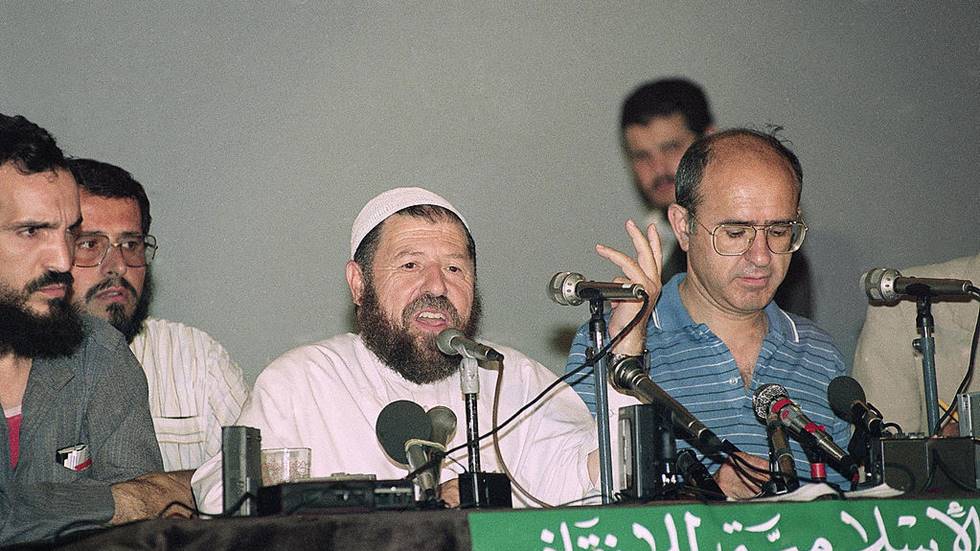
He wanted to return to Algeria to die. According to our sources, as illness had brought him back to that zone of extreme fragility where men no longer negotiate a role but an ending, Abbassi Madani undertook steps to come back. He was no longer asking for a party, nor a platform, nor the impossible revenge of the interrupted second round of elections. He simply wanted to finish his life at home. The state refused. Not because it still feared the former leader of the Islamic Salvation Front, who was by then diminished, hospitalized and almost withdrawn from the world, but because he had never apologized to Algerians. The authorities ultimately agreed to allow his body to be buried in the country. The living man was not granted return. His remains, however, were admitted.
This scene encapsulates the enigma of Abbassi Madani. His supporters sought to restore him to national memory in the guise of a mujahid, a professor, and a sheikh. His opponents continued to see in him one of the political figures responsible for the Algerian tragedy. Between the two, the state chose a cold line: no symbolic reconciliation without a word of repentance, but no prohibition of burial either. The body could return. The man, however, could no longer be reintegrated into the nation without confronting the question of the dead.
Madani died in Doha on April 24, 2019, far from the Algeria he had sought to refound in the name of Islam and November. His coffin returned to Algiers in an atmosphere of mourning, fervor, and unease. For some, the burial was that of a former fighter of 1954. For others, it was that of a man who had never clearly stated what he regretted about the political disaster to which his movement had contributed.
A coffin under the Algerian flag
The images from the end speak volumes. In Doha, the body is wrapped in the Algerian flag. The funeral prayer takes place in Qatari exile, far from the popular neighborhoods of Algiers where his name had once drawn crowds into the streets. Then the remains return. In Algiers, thousands accompanied the procession to the Sidi M’hamed cemetery. The crowd does not prove innocence. It only shows that the memory of the FIS, even defeated, even banned, even buried under three decades of fear and silence, has never completely disappeared.
Within this crowd, some saw a leader unjustly broken by the army, the symbol of a confiscated electoral victory, a man whose military trial and house arrest had confirmed the authoritarianism of the regime. Others, absent or silent, saw above all the face of a catastrophe. For them, the name Madani did not primarily evoke law or exile, but the rupture of 1991, the collapse of politics, the years when Algeria was covered in blood.
The paradox was there, visible in the procession. The same man could be mourned as a mujahid and denounced as one of those responsible. The same coffin could be an object of loyalty for some, of bitterness for others. Death resolved nothing. On the contrary, it reopened an old struggle: how to narrate a man who was both a product of national history and an agent of its disaster?
This is why one must return to the beginning, before the stadiums, before the FIS, before the military tribunal of Blida. Abbassi Madani’s first public scene is not Islamist. It is colonial.
The First Colonial Photograph
In a clipping from L’Écho d’Alger, a group of young men appears beneath a terse headline: “The perpetrators of the attack on Radio Algeria placed under arrest warrants.” The vocabulary is that of the colonial order: attempted destruction of a building, criminal association, suspects. The French press sees the accused. Independent Algeria would later see the revolutionaries of November.
Abbassi Madani thus enters history through one of the inaugural acts of the 1954 insurrection. He is not yet the professor, nor the Islamist leader, nor the prisoner of Blida, nor the old exile of Doha. He is a young man caught up in the first night of the war of independence, in that zone where anti-colonial violence is still treated by the French administration as common criminality. This first image would count throughout his life.
For Madani drew from November more than a memory. He would transform it into a title of entitlement. Many Algerian Islamist figures could invoke religion, preaching, morality, or the rejection of the FLN. He could also invoke the war. He could say, explicitly or implicitly, that he had preceded the independent State, that he had paid before the others, that he was not an interloper in the national story.
This legitimacy would become a formidable weapon. Madani would not contest the Algerian regime from outside the national narrative. He would contest it from its very center. The regime invoked November, but Madani would retort that November had been betrayed. The regime invoked Islam, but Madani would say it had been emptied of its substance. The regime invoked Arabism, but Madani would argue that it remained incomplete, compromised, Frenchified.
November as Political Capital
For Abbassi Madani, November was never merely a biographical episode. It was a political grammar. The former anti-colonial militant presented himself as the heir to a disfigured promise. According to this reading, independence had not produced the Islamic, moral State that the sacrifices of the war should have given birth to. Instead, it produced a single-party, socialist, authoritarian regime that is francophone in its reflexes, suspected of having confiscated both Islam and the people.
This Islamist reading of November is reductive. Nour-Eddine Boukrouh, former minister and founder of the PRA, recalled in a post published on his Facebook page that the passage from the November 1st Appeal promising a “sovereign, democratic, and social State within the framework of Islamic principles” did not point to a theocratic project. In his view, it reflected a cultural compromise with the Muslim sensibility of the Algerian people, while the Appeal also guaranteed fundamental freedoms “without distinction of race or religion.”
The Islamist narrative of November is debatable, partial, at times mythological. It erases the pluralities of the liberation war, the internal conflicts within the national movement, the debates over the State, modernity, women, languages, and social justice. But it was politically effective. It allowed a transformation of anger against the FLN into a charge of betrayal. The regime was no longer merely corrupt or ineffective. It became faithless to its origins.
It is here that a large part of Madani’s responsibility is bound up. He gave to a political and social crisis a totalizing religious translation. He cast disagreement with the regime as a question of fidelity to God, to November, and to national identity. In a society wracked by humiliations, shortages, bureaucracy, injustice, and disillusionment, this kind of rhetoric carried enormous power. It offered the vanquished of the system not merely an opposition, but a moral revenge.
But it also narrowed the space for compromise. If power is simply bad, it can be defeated. If it is impious, treacherous, and illegitimate in its very essence, it must be overthrown. This difference would prove tragic when ballot boxes, the streets, the army, and religion would all be caught in the same machinery.
A Man of Institutions
Before he was a man of rupture, Madani was nonetheless a man on the inside. After independence, he studied, taught, and entered the university. The Official Gazette shows him associated, in 1972, with the permanent commission for the Arabization of the University of Algiers. This administrative detail is more significant than it might appear. It situates Madani within one of the great ideological projects of the post-colonial State: decolonizing language, Arabizing education, refounding the university, shifting the cultural center of gravity from a French-educated elite toward Arab-Islamic legitimacy.
Madani was therefore no pure outsider. He had frequented institutions, commissions, and the regime’s slogans. He had been among those Arabic-speaking or Arabizing cadres who believed, each in their own way, that independence should be continued on the cultural terrain. This initial proximity gives particular density to his later break. He did not oppose the State as a foreign body. He turned part of its own language against it.
The regime had exalted Islam as a component of national identity, but sought to keep it under control. Madani would demand that it become the source of law and sovereignty. The regime had promoted Arabization as historical reparation, but within a bureaucratic and authoritarian framework. Madani would make it a marker of religious and political loyalty. The regime had sacralized the liberation war. Madani would use it as an instrument of accusation.
This passage through the institutions makes it impossible to tell the story of Madani as a phenomenon arising from the margins. He was also the product of a State that manufactured the very categories Islamism would use against it.
The Wound of Recognition
Sociologist Nacer Djabi offers a precious key here. He recalls, in an article published in Al-Quds al-Arabi, having crossed paths with Madani on several occasions, as both lived in the center of Algiers, in Belouizdad (formerly Belcourt), and taught in related fields at the Institute of Social Sciences at the University of Algiers: Madani in educational sciences, Djabi in sociology. His perspective is therefore not that of a distant adversary, but of an intellectual neighbor, a colleague, a witness who saw the man before the icon obscured him.
Djabi also suggests a more intimate hypothesis. Before the FIS, Madani had belonged to a conservative national current. He had joined the FLN, stood in local elections, but had not, in independent Algeria, obtained the symbolic place that his past might have led him to expect. Imprisoned by the French from 1954 to 1962, absent from the decisive political reconfigurations of independence, he may have experienced this relative marginality as a form of estrangement. Djabi writes that this perceived “distancing” can help explain Madani’s radical oppositional orientation after independence.
This hypothesis does not replace ideological analysis. It enriches it. In Madani, radicalism can be read as the convergence of a religious vision of politics and a wound of non-recognition. He had been there at the beginning, but others had inherited the State. He could invoke November, but real power had eluded him. Later, the FIS would offer him what independent Algeria had not: a crowd, a role, a centrality.
1982: University as a Battlefield
The first major alarm came in 1982. The Algerian university became a space of confrontation among Islamists, progressives, Berberist activists, left-wing students, and the regime. At Ben Aknoun, on November 2, 1982, Kamel Amzal, a law student, was killed during clashes. Activist memory presents him as a “martyr of democracy,” assassinated by Islamist extremists. University chronicles of this episode describe a slain progressive student, the wounded, arrests, and a tension that quickly spilled beyond the campus.
This episode must be handled carefully. It does not serve to establish direct guilt for Madani in a specific murder. Documented testimony does not support that. But politically, it marks the entry of Islamist violence into the democratic and Berberist memory. For Madani’s supporters, 1982 was the year of repression against religious activists. For other Algerians, it was the year when fanaticism began to strike those who defended cultural pluralism, university freedom, and democratic unionism.
A few days later, on November 12, a public prayer and rally were held at the central faculty of Algiers. Those who lived through that sequence speak of thousands of participants, religious and moral demands, and calls for the Islamization of public space. The university ceased to be merely a place of learning. It became a platform, a political mosque, a theater of demonstration.
The State understood then that university prayer spaces could become hotbeds of opposition. It repressed, arrested, and surveilled. But in striking, it also consecrated. Madani emerged from this sequence not as a mere censured teacher, but as one of the names around which Islamic contestation could coalesce.
The “Bayan Ennassiha” and the Fear of Women
It is in this sequence that Nacer Djabi identifies a turning point. According to him, Madani’s trajectory took a clear turn toward conservative political Islam in the early 1980s. He mentions his involvement in organizing the rally at the central faculty in November 1982, from which emerged what was called the bayan ennassiha, the communiqué or manifesto of moral counsel. Djabi emphasizes one point above all: this text and this movement expressed hostile positions toward Algerian women, described as “moughila fi radji’iyyatiha“: deeply reactionary.
This observation is essential. It reminds us that the Islamist rise was not solely a challenge to the single party. It was also an anxious response to social transformation. Women were entering universities in greater numbers. They were becoming visible, educated, actors in the public sphere. For Djabi, this new presence may have frightened a current of Islamism that did not consider the university its natural ground and preferred the more masculine, more immediately mobilizable popular street
This reading gives the portrait a social dimension. The FIS did not arise solely against the State. It also arose against societal changes: mixed-gender spaces, women’s emancipation, cultural plurality, women’s presence in centers of learning, and the rise of a youth that no longer fit into the traditional patriarchal order.
Madani was not alone in this story, but he became one of its faces. His political Islam promised justice to the humiliated, but also a return to order. It spoke of morality, but behind the morality loomed a control of bodies, of women, of spaces, and of voices.
From Daawa to Party
Between 1982 and 1989, the Algerian Islamist movement took shape. Around figures such as Ahmed Sahnoun, Mahfoud Nahnah, Abbassi Madani, and others, the daawa, religious networks, preaching circles, and activist sociabilities gained visibility. Madani stood at the crossroads of preachers, religious academics, conservative militants, and future political entrepreneurs.
The FIS did not therefore appear like a meteor in the sky of 1989. It crystallized a long accumulation. Mosques had served as spaces for speech in a system where parties were prohibited. Campuses had served as ideological laboratories. Working-class neighborhoods had supplied the social mass. The single party, by closing the normal channels of representation, had allowed an energy to build underground that the pluralist opening would release with brutal force.
Madani then held a decisive advantage. He could speak to several audiences at once. To former nationalists, he recalled November. To Arabists, he promised the cultural completion of independence. To the religious, he offered an Islamized State. To the poor, he promised justice against the corrupt. To frustrated youth, he offered revenge. To conservative families, he promised moral order. This capacity for synthesis explains part of his ascent.
But it also contained an ambiguity. The FIS federated grievances that were not always identical. Some wanted social justice, others religious revenge, others the end of the FLN, others sharia, others simply a voice against humiliation. A movement so vast could win an election. It was far less certain it could govern without tearing itself apart or without imposing its hardest faction.
The FIS Enters Through the Door of the Law
The Official Gazette of 1989 gave this dynamic a legal form. The Islamic Salvation Front filed its founding documents. Abbassi Madani was its president, Ben Azzouz Zebda its vice-president, Ali Benhadj one of the founding bureau members. The scene is almost banal: names, birthdates, professions, a party recognized within the framework of political opening.
But history would give this paper a tragic weight. The FIS first entered the State through the door of law, before being expelled by dissolution, arrests, military trials, and clandestinity. In 1989, it was an authorized formation. In 1992, it became a banned organization. Between the two, Algeria would have experienced the briefest and most dangerous pluralist experiment in its post-independence history.
Madani occupied the place of an apparently moderate figure. He was older, more academic, more institutional than Ali Benhadj. He reassured certain observers who wished to believe in a leadership capable of containing the excesses of the base. But this image of relative moderation should not be exaggerated. Madani was not simply the old professor surrounded by young radicals. Documents from the 1980s already showed him committed to an anti-Marxist, deeply conservative hard line.
The tandem with Benhadj gave the FIS a formidable effectiveness. Madani brought historical legitimacy, age, status, and national grounding. Benhadj brought fervor, verbal violence, and the ability to magnetize young militants. One gave the movement respectability; the other gave it revolutionary tension. Together, they transformed a religious current into a force of conquest.
The Popular Wave
In June 1990, the FIS won the first pluralist local elections. The victory was massive. Images from rallies (especially at the 5-Juillet stadium) showed a movement capable of filling stands, saturating public space, and giving its supporters the sense that history was changing sides. The FLN, the single party of independence, was humiliated. The State discovered that a force it believed it could channel was capable of defeating it at the ballot box.
This victory was carried by considerable social energy. It came from working-class neighborhoods, unemployed youth, frustrated middle classes, marginalized Arabists, pious merchants, and families exasperated by bureaucratic arrogance. The FIS appeared as an instrument of punishment. To vote FIS was to sanction the FLN, its privileges, corruption, and injustice. It was to say no to a system that no longer represented anyone in particular.
But this wave was not purely a protest. It carried a worldview. The municipalities won by the FIS became showcases of moralization, sometimes of coercive social order. Questions of dress, mixed spaces, culture, celebrations, women, language, and public conduct took on political importance. Municipal Islamism promised cleanliness, justice, and proximity, but it also heralded a society monitored by religious norms.
Madani was then at his zenith. He was no longer merely the former detainee of 1982. He was the face of a possible alternation. This is precisely what made his failure so weighty. For a social force of such magnitude could have compelled the State toward a negotiated transition. Instead, it would contribute to installing a confrontation in which each side suspected the other of wanting to annihilate it.
The FIS no longer thought of itself as one force among others. It experienced itself as the sole depositary of popular will. To other Islamist or political currents, it offered not a coalition, but submission.
In a testimony given to the program “Pour l’Histoire,” broadcast by El Khabar web TV, Abdallah Djaballah offered a counterpoint from within the Islamist movement itself. In his view, the Islamists were not “at the level required by the necessities and imperatives of pluralist democratic transition.” He says he made multiple overtures to the FIS without response, and describes its attitude as “blameworthy partisanship.” The 1991 strike was, for him, a “dangerous call” likely to open the door to violence.
In the spring of 1991, this majoritarian intoxication reached its breaking point: the indefinite political strike marked the tipping.
A Giant Without Doctrine
Nacer Djabi perhaps offers the most illuminating formula on the FIS. He describes it as a “haraka ijtimaiya chaabiya hadira“, a thunderous popular social wave, led by a political elite “min doun ‘omq fikri,” without intellectual depth. He adds that this lack of political experience was a traditional characteristic of Algerian Islamism.
This assessment is severe, but it helps avoid two simplifications. The FIS was not merely a theocratic conspiracy. It was an immense social push. But it was also not a mature party equipped with a governing doctrine, an institutional culture, a conception of pluralism, or a project capable of reassuring those who might be defeated in any alternation. It had the mass, the fervor, the historical moment. It lacked the political depth to transform that power into a peaceful exit from the system.
Djabi’s critique targets the leadership directly. Madani and his companions benefited from the initial momentum of a political giant, but they did not know how to master it. They rode an energy they had not entirely produced and no longer entirely controlled. The FIS was a party, but also a crowd; an organization, but also a national mood; an electoral offer, but also an outlet.
This may be one of the central knots of Madani’s responsibility. He did not merely radicalize a discourse. He accepted the role of embodying a wave whose limits, behavior, and loyalty to the democratic game he could not guarantee once victory was achieved. When a leader accepts being carried by a total rage, he becomes responsible for the moment when that rage overflows the frameworks he claimed to give it.
Madani Overtaken by His Base
Djabi recounts an illuminating scene. He once accompanied Madani to his home in Hydra. The FIS leader invited him to drink milk with dates from Biskra. In this almost domestic scene, the sociologist witnessed telephone calls from local militants asking Madani to intervene in field conflicts. The party’s grassroots had understood that the leader’s presence gave each conflict new media and political importance. They did not hesitate, according to Djabi, to exaggerate or present a distorted account of events.
The example he gives is telling: militants from Sour El Ghozlane called Madani to denounce a violent intervention by the gendarmerie against demonstrators after flooding. In reality, Djabi says, it was no more than ordinary scuffles over housing demands, as occurred in many Algerian towns at the time. But for the FIS grassroots, inflating the incident could attract the leader, therefore the press, therefore a shift in the balance of power.
This scene is revealing. It shows a Madani less as an omnipotent strategist than as a leader solicited, sometimes instrumentalized by his own base, caught in a circuit of permanent amplification. But this does not exonerate him. On the contrary. A responsible leader must know when his militants transform every social conflict into an episode of political confrontation. He must contain, prioritize, and verify. Madani appears to have been carried by a mechanism in which the leader’s intervention validated the exaggeration of the base.
The FIS thus became a national echo chamber. A local housing problem, an altercation, an administrative decision, a gendarmerie intervention could all be folded into a general narrative of persecution and uprising. This is how societies enter into crisis: when every event becomes proof of a total war.
1991: The Street Against the State
The crisis of 1991 officially arose from electoral law and the redrawing of constituencies. The FIS accused the regime of preparing institutional fraud to limit its gains in the legislative elections. Madani called a strike. The squares of Algiers were occupied. Sit-ins took hold. The street became an instrument of pressure on the State. The regime negotiated, hesitated, then decided to strike. The memoirs of Khaled Nezzar, which are to be read as the account of a central actor within the military institution, shed light on the way the army reconstructed this sequence.
The state of siege was decreed in June 1991. The army intervened. The sit-ins were dispersed. There were deaths, injuries, arrests. There were also internal dissensions within the FIS: figures who criticized the confrontational line, militants and leaders who broke ranks and appeared on television. Already, the movement appeared to be working against its own contradictions. The leadership sought to exert pressure through the street, but the street produced its own logic. The regime sought to restore order, but its intervention reinforced the Islamist narrative of persecution.
On June 30, 1991, Abbassi Madani and Ali Benhadj were arrested. This arrest deprived the FIS of its two main figures, but did not defuse the crisis. It displaced it. The party was weakened at its head, strengthened in its myth. The leaders became prisoners. Militants could think of themselves as betrayed, robbed, attacked. The State, by neutralizing Madani, also transformed his image: the disputed tribune became, for his supporters, a political prisoner.
Once again, both truths coexist. The regime used force to regain control. But Madani had engaged his movement in a street confrontation whose outcome he did not control. He knew that a standoff with a militarized State could not remain symbolic for long.
The Military Trial in Blida
The Blida trial of 1992 crystallized the rupture. Abbassi Madani and Ali Benhadj were sentenced to twelve years in prison by the military tribunal. The front pages of El Khabar and the national press conveyed the brutality of the moment: the two FIS leaders were struck at the heart, while other cadres received lighter sentences. The verdict did not close the crisis. It hardened it.
The announcement of the sentence provoked demonstrations in Algiers, Sétif, and Batna on July 16 and 17, 1992, resulting in three deaths, fifteen wounded, and seventy arrests. Military justice, meant to fix responsibility, became new political fuel. The regime sought to neutralize. It also manufactured symbols.
The context was already one of collapse. The FIS had won the first round of the December 1991 legislative elections. Chadli Bendjedid left power in January 1992. The electoral process was interrupted. A state of emergency was proclaimed. The FIS was dissolved. Thousands of militants were arrested or sent to camps in the south. The underground expanded. Armed violence began to organize.
The trial of Madani was therefore not merely judicial. It was one of the acts by which the regime sought to convert a political crisis into a security matter. The State maintained that the FIS was preparing an insurrection and threatening to establish a theocratic State. The defense replied that the aim was to eliminate the leader of the main opposition party. These two narratives are still in conflict today.
But the central question remains: even if the State violated legal guarantees, that is not sufficient to transform Madani into a frustrated democrat. And even if Madani bore a major political responsibility, that does not justify military exception as a mode of justice.
Rupture and Blood
After 1992, Algeria entered a long night. The legal FIS disappeared. Armed violence spread. According to security service reports, the number of armed Islamists reached 32,000 in 1993. The AIS, the GIA, local maquis, radicalized factions, but also self-defense groups, score-settling, and manipulation composed an increasingly illegible landscape. Civilians became the hostages of a war in which each side claimed to speak in the name of salvation.
Teachers, journalists, artists, civil servants, women who refused the imposed order, villagers suspected of supporting security forces, anonymous families, children, travelers on the roads, and inhabitants of the peripheries paid the price. The Black Decade cannot be reduced to a single man. But it cannot be told by removing Madani from the political chain that preceded it.
His responsibility is not that of a massacre leader. It is more fundamental and more political. He helped draw Algeria into a logic of existential confrontation. He gave an immense social anger an exclusive religious form. He led a movement that did not know how (or did not want) to reassure those who feared that an Islamist victory would mean the end of pluralism.
Madani’s supporters reply that the bloodshed stems from the interruption of the electoral process, from repression, from the camps, from torture, from the humiliation of the popular victory. This is part of the truth. But it is not enough. For a political movement that aspires to govern must also be judged by what it promises to opponents, minorities, women, and the vanquished. On this point, the FIS failed even before holding power.
A Responsibility Without Absolution
The most difficult line must therefore be held: the Algerian State committed arbitrariness, and Madani bears heavy political responsibility. Neither truth erases the other. The regime interrupted an electoral process, tried civilians before military courts, engaged in mass internment, closed political space, and responded to a legitimacy crisis by force. But Madani was not merely the innocent representative of a confiscated alternation. He was the leader of a movement whose relationship to democracy remained instrumental, ambiguous, and unsettling.
The FIS spoke in the name of the people, but which people? Those who voted for it, or also those who rejected it? It spoke in the name of Islam, but what became of the Algerians who did not want the State subjected to a single religious norm? It spoke in the name of November, but what remained of the real pluralism of the liberation war, of its currents, its contradictions, its women, its modernists, its socialists, its non-Islamist nationalists?
Madani never answered these questions convincingly. His authority rested on the synthesis between mujahid, professor, and religious leader. But this synthesis served to push Algeria toward a closed alternative: the regime or Islam, corruption or purity, betrayal or salvation. This language is politically dangerous because it transforms the adversary into a moral obstacle.
It is here that the apology the State awaited takes on its meaning. It was not merely about regretting a defeat. It was about acknowledging that a political discourse can contribute to making tragedy possible.
The War Overtakes Its Founders
As the war advanced, Madani lost control of the history he had helped to open. The FIS’s historical leaders were imprisoned, marginalized, or silenced. Armed groups imposed their own logic. The AIS, linked to the dissolved party’s movement, sought a form of political-military discipline. The GIA pushed terror to absolute horror. Civilian massacres sent Algeria into a zone where ordinary political categories collapsed.
Then came 1997. Secret negotiations opened with the AIS. The truce announced in September 1997 was part of a strategy to separate negotiable armed Islamists from groups destined for eradication. In this context, Abdelkader Hachani and then Abbassi Madani were released. But this release was not a triumphant return. It showed rather that the center of gravity had shifted.
In 1990, Madani filled stadiums. In 1997, he was a symbolic piece in a security game that was playing out largely without him. The regime could still use his name, his supporters could still see in it a legitimacy, but the war had produced its own leaders, its own circuits, its own monsters.
This dispossession does not erase his initial responsibility. It merely illustrates one of the laws of radicalization: those who open the door to a logic of rupture are not always those who decide what enters next. Madani embodied the wave. Then the wave surpassed him. The FIS leader became an old man under surveillance while others spoke with weapons.
The UN and the State of Exception
The case file before the UN Human Rights Committee, brought by his son Salim Abbassi (Communication No. 1172/2003), offers another perspective. It does not judge the FIS’s political history. It judges the rights of a man: arrest, military trial, detention, house arrest, freedom of movement, judicial guarantees. It reminds that a State does not cease to be bound by law because its adversary is dangerous.
The Committee concluded that significant violations had occurred. House arrest was equated with arbitrary deprivation of liberty. The recourse to a military tribunal to try a civilian was not sufficiently justified. Algeria was thus found in violation of Articles 9 and 14 of the International Covenant on Civil and Political Rights. The Committee did not, however, find a violation of freedom of expression for lack of sufficient evidence.
This decision prevents any one-sided portrait. Madani was a political actor of rupture. But he was also a victim of State arbitrariness. His military trial and prolonged house arrest fed the memory of his supporters and gave weight to the political prisoner argument. The State, by seeking to neutralize a dangerous leader, confirmed part of the indictment the Islamists leveled against it: that of a power incapable of treating its adversaries within a civil and loyal framework.
But the UN ruling does not cleanse Madani of his historical responsibility. It does not say the FIS was democratic. It does not say its project was reassuring. It says that the State violated the law. That is already much. It is not an absolution.
Doha: The Old Man in Exile
In 2003, Madani left Algeria for Malaysia and then Qatar. Exile transformed the FIS leader into a twilight figure. He no longer directed anything of consequence. He received visitors, wrote, appeared, fell silent, survived. Images in circulation showed him aged, ill, surrounded by family, sometimes hospitalized: a sharp contrast with the Madani of the crowds. The body had replaced the voice. Weakness had replaced the platform.
Around him, part of the family settled in Qatar. His son Salim, who had filed the complaint before the Human Rights Committee, subsequently built a career there, eventually holding leadership roles in the solar energy sector. This dimension should not be overstated. It nonetheless says something about the end of the cycle: the man who had sought to refound the Algerian State ended his days far from it, in a protective Gulf, surrounded by a respectability in exile that contrasts with the ruins left in national memory.
Exile was not merely familial or medical. It also became a space of speech. From this political diaspora, part of the FIS memory was recomposed, notably through media outlets established outside Algeria. Created in London in 2011 and subsequently based in Paris, Al Magharibia was part of the media environment of radical Islamist networks stemming from the FIS. Its founder, Oussama Madani, is one of Abbassi Madani’s sons. The detail is not incidental: after the father’s political defeat and exile, part of the family and militant narrative shifted toward transnational media space.
Doha thus became an ambiguous setting. For his loyalists, it was the place of prolonged injustice, an exile imposed on a man prevented from living freely in his country. For his critics, it was the site of a flight from Algerian history, a relative comfort obtained after a tragedy paid for by others. The truth may be simpler and sadder: Madani could no longer exert any influence. He had become a name, a body, a living archive.
But some names never fully age. Even ill, Madani remained bound to an unresolved question: what is to be done with those who were at once repressed by the State and responsible for having pushed it toward the abyss?
“Algeria Was in His Hands”
The final scene recounted by Nacer Djabi is one of the most striking. He encountered Madani again in Doha, years later, in the floors of the Sheraton, dressed in his traditional clothing. The sociologist says he reflected on this sad ending. Then he wrote this stark phrase: Algeria was in his hands, but he did not know how to preserve it, as he had known how to preserve his traditional garment.
This formula sounds like a political epitaph. It does not mean that Madani literally possessed Algeria. It means that he held, for a moment, an immense historical possibility. In 1990 and 1991, he could have transformed a popular surge into a national negotiation, a pluralist refoundation, a real democratic pressure on the regime. He could have imposed a transition without only reassuring his own supporters. He needed to speak to the other Algerians too: to those who feared the FIS, to women, to democrats, to Berberists, to secularists, to civil servants, to political minorities, to FLN voters, to the indifferent.
He did not do so. Or not sufficiently. He chose to embody a wave rather than discipline it. He allowed an electoral majority, religious truth, and revolutionary legitimacy to become fused. He believed he could carry a rage that had already surpassed him. That is what Djabi encapsulates in saying that Algeria was in his hands. Not a power already won, but a historical chance. Not a right to govern, but a responsibility before society.
The failure is therefore not merely that of a man defeated by the army. It is that of a leader incapable of transforming popular force into a political project that all could inhabit.
To die Without Asking for Forgiveness
In the end, everything returns to this absence of apology. According to our sources, the State refused the return of the living man because Abbassi Madani had not asked the Algerian people for forgiveness. The phrase may seem harsh, especially coming from a State that itself never fully accounted for its own violence. But it touches on a central point. Madani denounced the interruption of the electoral process, the repression, the injustice, the prison, the exile. He did not deliver the moral statement that many awaited: the acknowledgment that his movement had contributed to opening a tragic sequence.
Would apologies have sufficed? Probably not. They would not have brought back the dead. They would not have erased the massacres, the disappearances, the fears, the bereavements, the fractures. They would not have absolved the State or healed the families. But they would have introduced a crack in the closed memory of the FIS. They would have said that the confiscated victory does not justify everything, that the repression suffered does not erase the responsibility exercised, that the status of victim of arbitrariness does not cancel the debt to society.
Madani died without those words. His supporters remembered the mujahid, the professor, the prisoner, the exile. His opponents remembered the leader of a movement that drew Algeria into an all-or-nothing logic. Between the two, there remains an uncomfortable truth: Abbassi Madani was sufficiently Algerian to embody the contradictions of his country, and sufficiently powerful to help make them murderous.
His name remains incendiary because it does not refer only to the FIS. It compels Algeria to look at what made the FIS possible: an authoritarian State, a humiliated society, a politicized religion, an opposition without a solid democratic culture, a memory of November transformed into a weapon. That is why his portrait can be neither a simple indictment nor an elegy. It is the story of a man who sought to judge the State in the name of Islam and the revolution, but who never accepted being judged by the Algerians for the catastrophe that this pretension helped produce.

